BT Single Line Call Logger · c.1990
Monolog

Call Logger Documentation

A compact, line-powered call logging unit developed by British Telecom for use in disputed account investigations. This site documents both hardware generations, the software suite, interfaces and firmware.

Explore Hardware Software Docs
At a Glance
GenerationsMark I & Mark II
Introducedc. 1990
Call storage2,000 – 10,000
Standby current180 µA
Dial-up interface300 bd · V21
RS-232 (Mk II)9600 bd · 8N1
Background & History

Origins

The requirement for sophisticated call-logging equipment goes back to 1984, when the Network, Systems and Technical Security Group of British Telecom's Network Operational Support unit (NOS) was investigating the irregular activities of certain computer hackers.

The case in question involved the hacking of the Duke of Edinburgh's Prestel account by Steve Gold and Robert Schifreen — a landmark case that ultimately led to the creation of the Computer Misuse Act 1990. At the time, no equipment existed to provide reliable evidence of fraudulent computer access. A prototype device — the data monitor — was rapidly developed and assembled to meet this need.

When the case came to trial, timing discrepancies of up to three minutes between the data monitor, its associated call logger, and the hacked computer system became a significant feature of the proceedings. To prevent such problems in future investigations, the data monitor was expanded to include its own integrated call-logging capability.

The standalone call-logging element was subsequently developed independently as the Line Event Recorder (LER) — accurate, reliable and highly portable. A further development, sponsored by NOS, added metering detection and a complete redesign of the hardware, producing the Monolog system described here.

↗ BBC News — Archive of historic BT email hack preserved
Postscript

Where does Monolog fit in the 21st Century?

Probably nowhere — and that is not entirely a sad thing. The introduction of per-second call pricing in 1998, followed by the phased withdrawal of the Meter Pulse Facility (MPF) between March 2007 and September 2008, effectively removed most of Monolog's core purpose. Without MPF, the ability to independently verify a subscriber's billing — the very reason Monolog existed — was largely lost.

The original support software — DIALOG, CHECKLOG, PRINTOUT — was written for 16-bit and 32-bit MS-DOS environments. In today's 64-bit world, none of it runs natively without an emulator, and its command-line character sits awkwardly alongside modern graphical interfaces. The underlying hardware faces a more fundamental problem still: it is built entirely around low-speed analogue dial-up technology, which is now largely obsolete.

The gradual demise of the traditional analogue telephone line — and the UK PSTN closure scheduled for January 2027 — marks the final chapter. Monolog is a product of its era: ingeniously conceived, carefully engineered, and now a piece of telecommunications history.

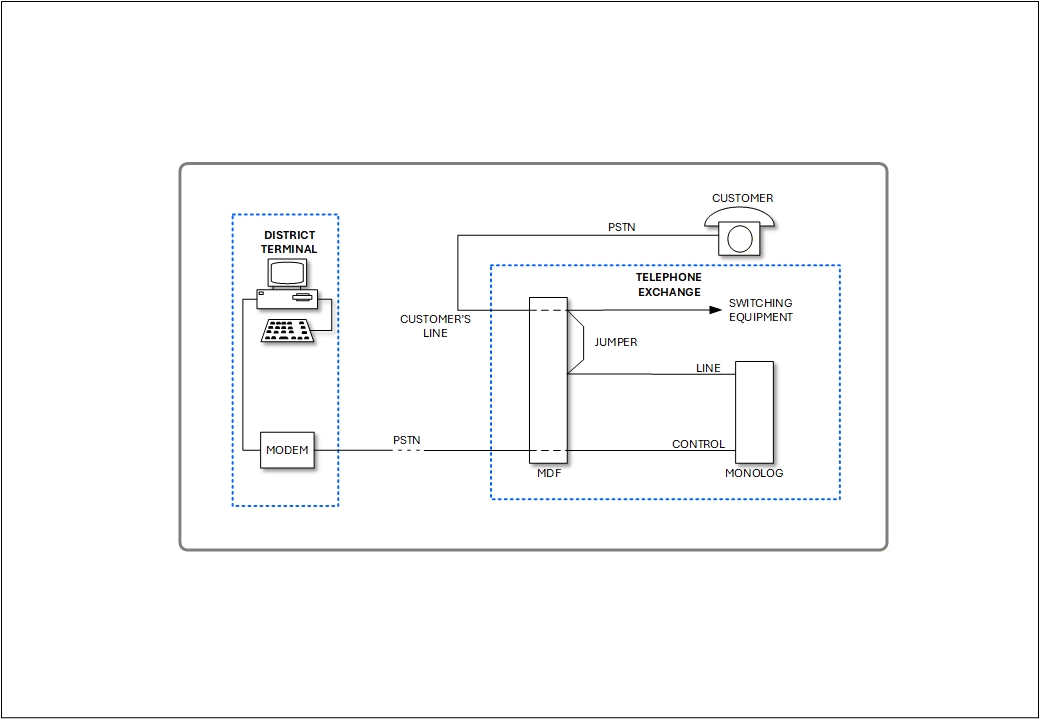
Monolog typical exchange installation diagram

Fig. 1 — Typical exchange installation showing District Terminal, MDF and Monolog connected via PSTN control line

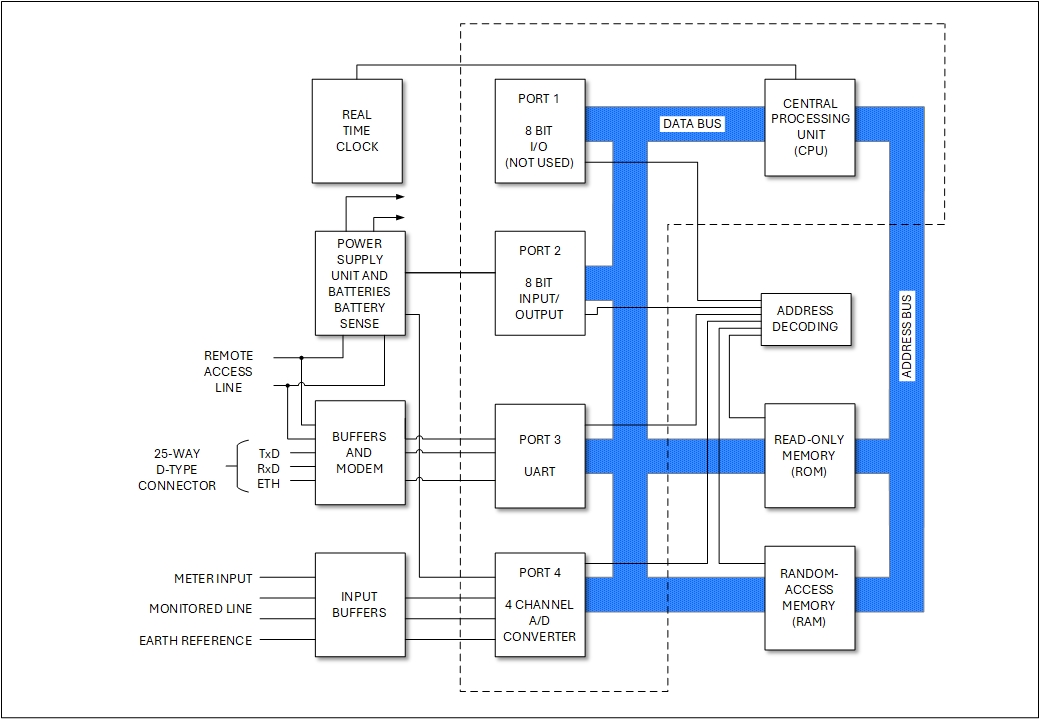
Monolog system block diagram

Fig. 2 — Monolog system block diagram showing CPU, ROM, RAM, UART, modem and A/D converter architecture

Development

1984
The Hack
Gold & Schifreen access the Duke of Edinburgh's Prestel account. BT NOS begin developing the data monitor prototype.
c. 1986
Line Event Recorder
The call-logging element of the data monitor is developed independently as the LER — portable, accurate, but without metering detection.
1989
Monolog Mark I
Complete redesign produces Monolog. Over 1,000,000 calls recorded during evaluation without a single timing or digit error.
1991
Monolog Mark II
Following BT's April 1991 rebrand, the Mark II introduces direct RS-232 connectivity at 9600 baud alongside the dial-up interface.
Hardware Variants

The Units

Three physical variants of Monolog were produced. All share identical electronics — only the enclosure differs. Click any image to enlarge.

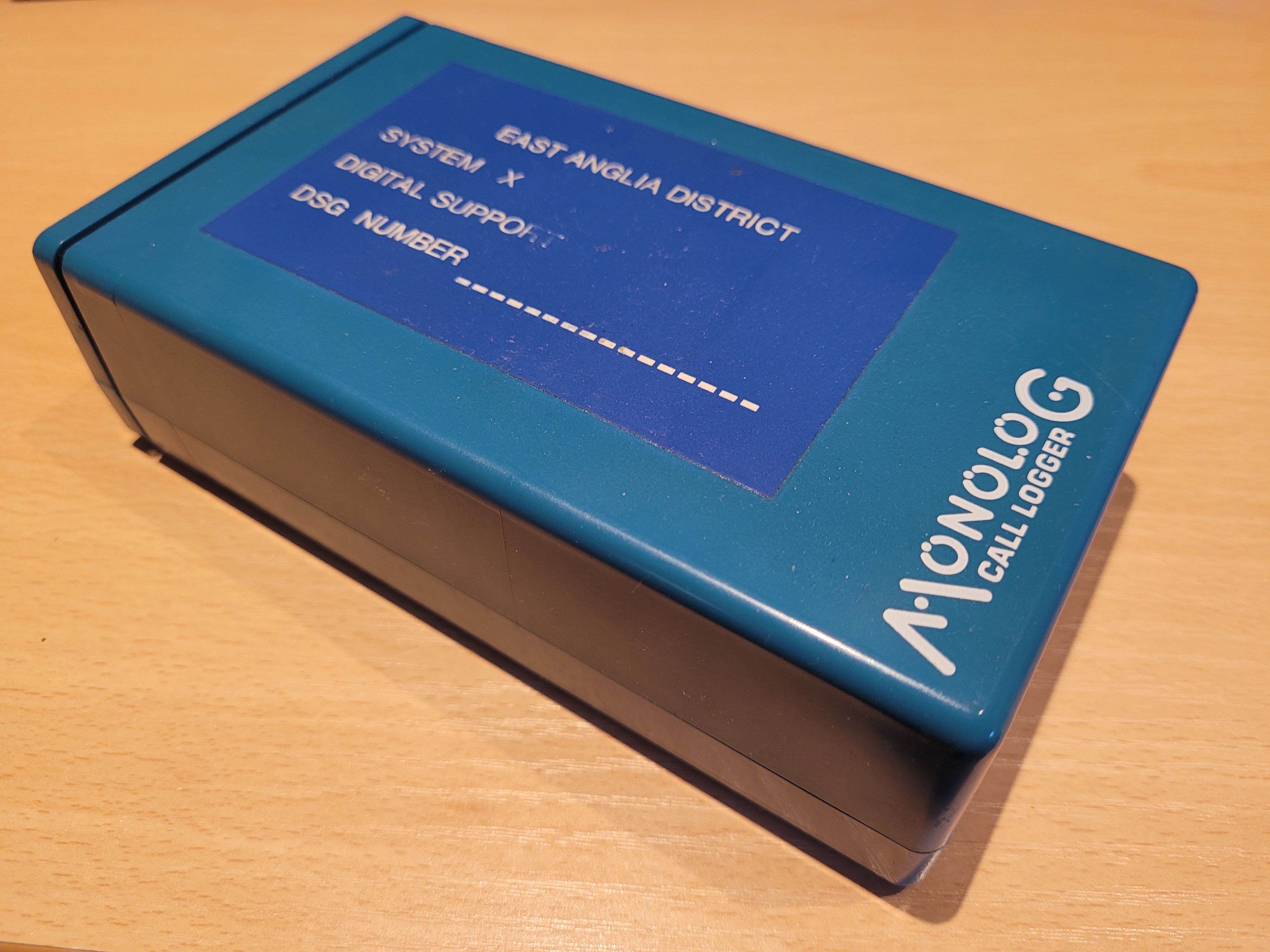
Mark I — Blue polycarbonate enclosure
click to enlarge
Mark I Blue · Plastic

Blue polycarbonate enclosure. Pre-1991 British Telecom livery. The original production variant.

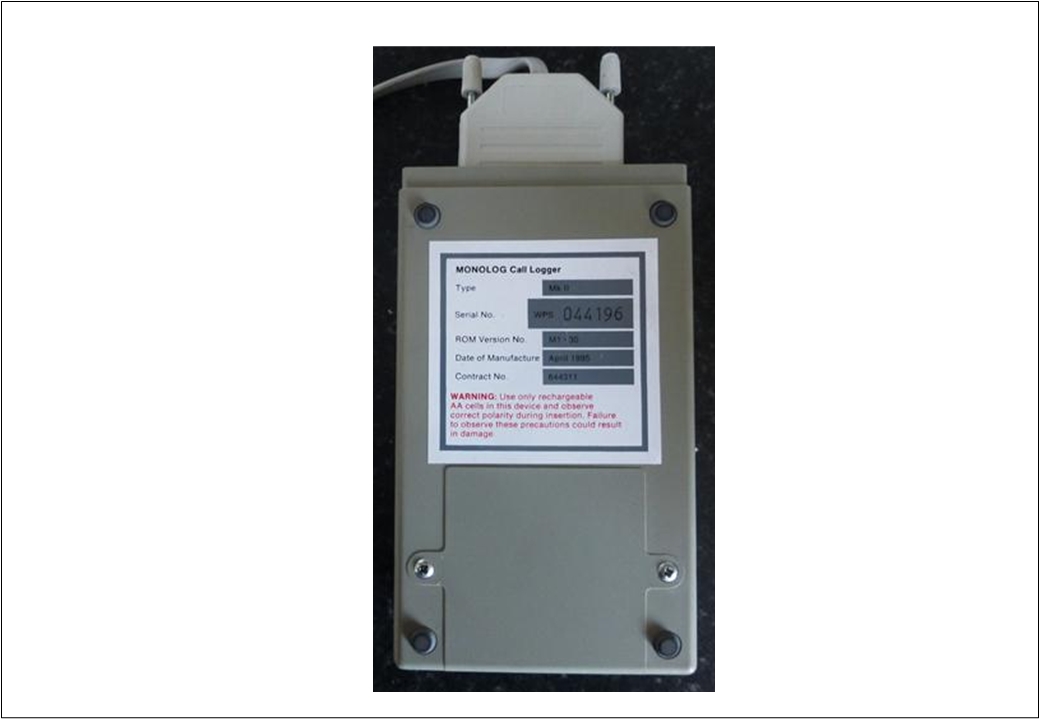
Mark II — Grey polycarbonate enclosure
click to enlarge
Mark II Grey · Plastic

Grey polycarbonate enclosure. Post-1991 BT livery. The plastic variants developed a characteristic stress crack at the edge of the battery compartment — a known weak point in the moulding.

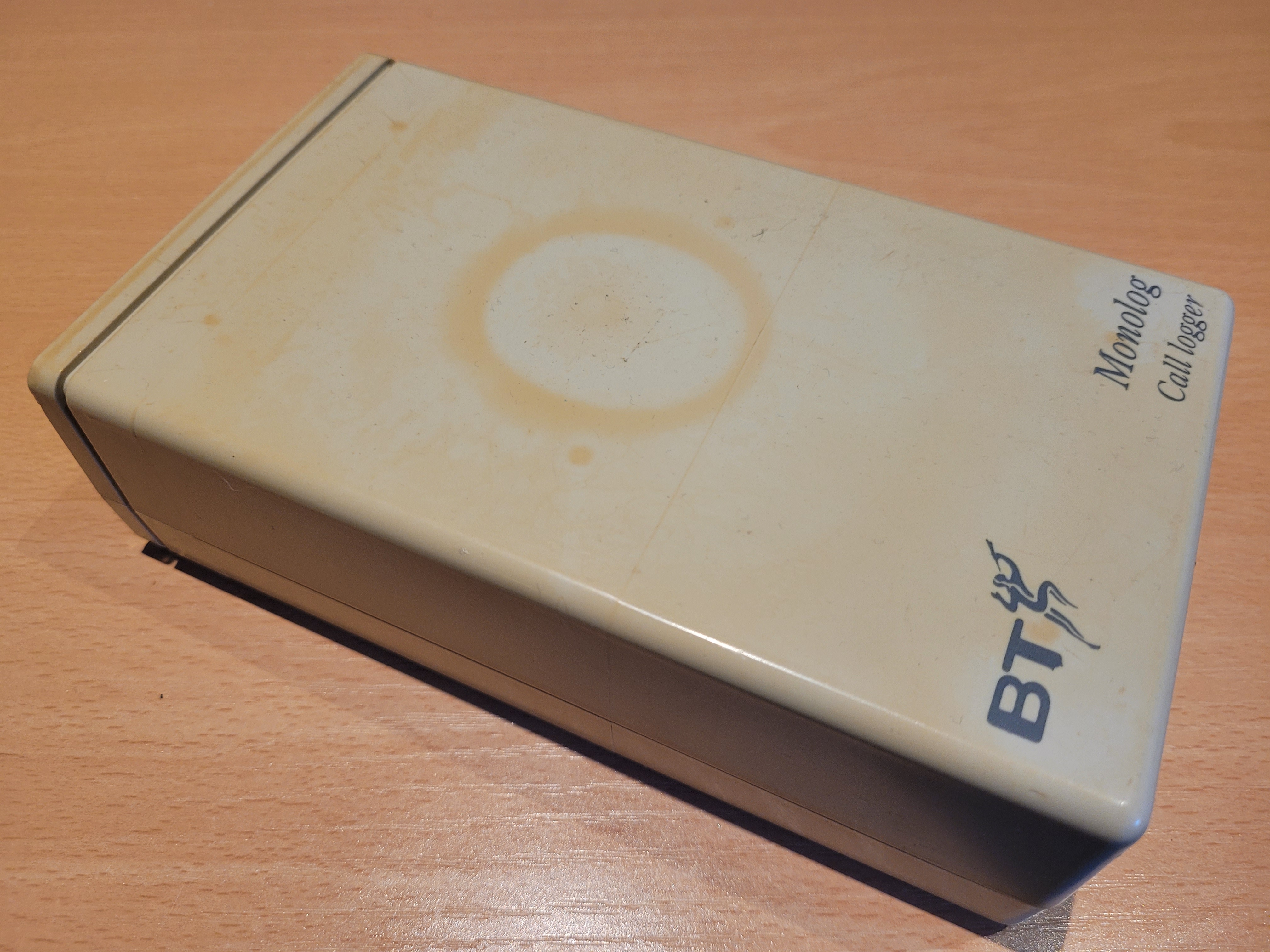
Mark II — Grey metal enclosure
click to enlarge
Mark II Grey · Metal

Grey metal enclosure. Introduced to address the cracking problems of the polycarbonate cases — considerably more rugged in the field. The rarest of the three variants.

WANTED
Mark II Metal Enclosure — Looking for a Home

If you have a Mark II Monolog in a metal enclosure looking for a new home, please get in touch — it would be very welcome here.

Documentation Sections

01
Hardware
Mark I and Mark II units — specifications, line connections, memory options, batteries and physical installation.
02
Interfaces
Monolog Interface Unit (MIU) and Monolog Exchange Interface Kit (MEIK) — purpose, connections and usage.
03
Software
DIALOG, CHECKLOG and PRINTOUT — the original DOS suite plus the modern Python reimplementation.
04
Command Reference
Full listing of all Monolog commands with syntax, parameters and examples for both generations.
05
PCBs
Board layouts, component detail and photographs of the Mark I and Mark II printed circuit boards.
06
Downloads
EPROM hex files, dialog.py, original DOS software and the Monolog Call Logger Handbook.